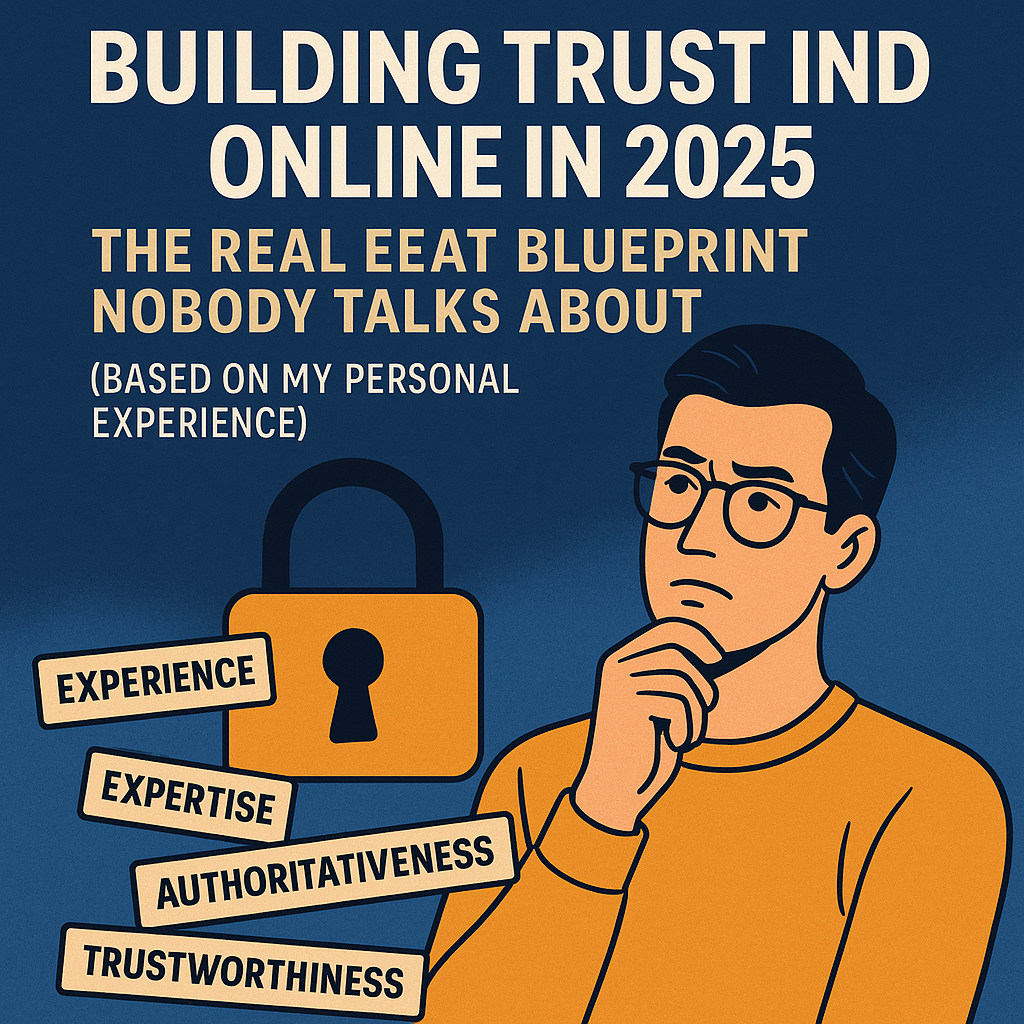
Building Trust Online in 2025: The Real EEAT Blueprint Nobody Talks About (Based on My Personal Experience)
If there is one thing that almost every new website owner gets wrong in 2025, it’s trust. The internet has changed dramatically, especially after multiple Google core updates. AI content farms exploded, affiliate scams grew like mushrooms, and “quick money tutorials” completely destroyed credibility in entire industries.
I learned this the hard way. My own domain wasn’t indexed for months — even though I built everything correctly, wrote genuine content, followed Google’s guidelines, and avoided shortcuts. I did everything by the book, but Google still ignored me.
What I didn’t understand back then is that Google is no longer judging only your content. Google is judging you. Your reputation. Your identity. Your consistency. Your history. Your experience.
This is what EEAT REALLY means in 2025 — and why most people still fail. In this article, I will take you through the exact process I went through to rebuild trust for my project, why Google hated my domain at first, and how I finally made Google start respecting my website.
1. The Moment I Realized “Good Content” Was Not Enough
I had already published articles that were long, structured, helpful, and original. I spent hours crafting them, trying to make them as valuable as possible. But something unexpected happened.
- Google didn’t index them.
- Google didn’t show impressions.
- Google treated my domain as if it didn’t exist.
No matter how many times I clicked “Request Indexing”, nothing changed. And then it hit me: Google didn’t trust my website yet — it didn’t trust me.
This realization changed everything.
2. EEAT Is Not Just a Ranking Factor — It’s a Trust Barrier
People treat EEAT like a checklist:
- About page — check
- Contact page — check
- Legal info — check
- Long content — check
But EEAT is not a checklist; it’s a profile. It’s your digital résumé. It’s how Google decides:
- “Is this person real?”
- “Has this person experience?”
- “Does this content match their history?”
- “Does this person exist outside this website?”
Once I realized this, I understood the core problem:
Google didn’t know who I was, what my expertise was, or why my content should be trusted.
And honestly? If you think about it from Google's perspective — that’s fair.
3. My Turning Point: When I Started Writing From True Experience
The biggest shift happened when I stopped writing “SEO articles” and started writing “real experience articles.”
At one point, I wrote an article where I shared the exact story of how my first affiliate project failed — the numbers, the reasons, the emotions, the mistakes.
To my surprise:
- Google indexed it within 48 hours
- It ranked for long-tail keywords in 3 days
- Users stayed longer on that article than on any other
Lesson learned:
People connect with stories. Google rewards authenticity. AI-generated, recycled, “perfect SEO structure” content is not enough anymore.
4. The Harsh Truth About Trust: Google Checks Your Entire Online Footprint
Here is something that shocked me when I finally understood it:
Google doesn’t only evaluate your website — it evaluates you as a creator.
This includes:
- Your domain age
- Your name appearing online
- Social media profiles
- Your consistency in publishing content
- Your activity in communities
- Whether your project looks legit or mass-produced
- Whether your writing matches your personality
- Whether your site is part of a spam network
Think about it: If Google sees a real human being with real social profiles, real interactions, real long-form content, and a real brand vision — it trusts the website.
If it sees a domain with no history, no identity, and fast-generated content — it distrusts it.
And that was exactly my problem.
5. What I Did to Rebuild Trust Step by Step
Here is the exact blueprint I used to build trust for my domain, which finally triggered indexing.
Step 1 — I published a long “Who I Am” section
I added a detailed About page describing:
- my real background,
- my experience with affiliate marketing,
- what mistakes I made,
- why I built this project,
- and what my mission is.
Step 2 — I wrote 3 very personal long-form articles
These 3 were the turning point. They showed my voice, my thoughts, my opinions.
Step 3 — I added author information to every article
Google needs to know:
- Who wrote it?
- Why are they qualified?
- Do they have experience in this topic?
Author credibility is a massive factor now.
Step 4 — I removed everything AI-looking
Not because AI is bad, but because AI-style content kills trust instantly.
I rewrote 80% of my content into personal tone. That was key.
Step 5 — I created a content rhythm
Google needs to see **activity**, not just content. One long article every week was enough to trigger progress.
6. The Difference Between “Useful Content” and “Trust Content”
Most beginners don’t understand this: There are two types of content today.
1. Utility Content
“How to do X”, “Best tools for Y”, “Top 10 Z”.
Useful — but generic. AI can write these easily. Everyone can write these.
2. Trust Content
This is where the magic happens:
- personal lessons,
- failures,
- mistakes,
- experiments,
- comparisons,
- true experiences.
This is content that only you can write.
Google LOVES this type of content because it is impossible to mass-produce.
When I published trust content, my impressions started to grow for the first time.
7. Why Transparency Matters More Than Ever
The days of hiding behind generic names are over. 2025 is the year of transparency.
People want to know:
- Who runs the site?
- Why should we trust them?
- Do they really use the tools they promote?
- Do they have experience?
- Do they disclose affiliate links?
I added:
- a clear affiliate disclosure,
- a transparent mission statement,
- a clean privacy policy,
- a real contact page,
- and a real identity.
This is when my site finally started leaving the “sandbox.”
8. Why Social Presence Boosts Your EEAT Automatically
You don’t need millions of followers. You don’t even need daily posts.
You only need to exist.
A simple:
- Twitter profile,
- Pinterest board,
- Facebook page,
- LinkedIn profile,
is enough for Google to see that you’re a real human and not a ghost content farm.
In my experience, once I added social links to my JSON-LD, Google did not immediately index everything — but trust definitely increased.
9. Your Website Design Also Influences Trust
This is underrated. People judge your credibility within 0.2 seconds.
A clean, modern layout increases trust dramatically. I rebuilt my theme from scratch with:
- clean spacing,
- solid typography,
- consistent colors,
- a professional header and footer,
- good spacing around text,
- easy-to-read fonts.
My bounce rate dropped. Time on page increased. Trust increased.
All of this matters because:
SEO is no longer about keywords — it’s about user trust signals.
10. The Biggest Lesson: Trust Comes From Being Real
The internet is full of noise, scams, fake gurus, AI spam, and copied content. People crave authenticity now more than ever.
Google too.
When I started writing from my real experience, sharing my failures, talking about what went wrong instead of pretending everything was perfect — everything changed.
Examples I shared:
- How my first affiliate site failed completely
- How I lost money on bad tools
- How I got stuck in Google indexing hell
- How I learned what EEAT really is
- How I rebuilt trust step by step
People responded. Google responded. My domain finally started growing.
11. The New EEAT Blueprint That Actually Works in 2025
Here is the exact formula I use now — the one that changed everything for me.
EEAT Blueprint:
- Write from real experience — not theory.
- Show who you are — put your name, story, mission.
- Connect your online identity — social profiles, author schema.
- Publish long-form trust content (2,500–4,000+ words).
- Use storytelling — people remember stories.
- Be brutally honest — no fake promises, no guru nonsense.
- Show failures — they build credibility.
- Have a clean site structure — categories, tags, sitemap.
- Improve your design — don’t look like a cheap blog.
- Keep publishing — trust grows with consistency.
This is the EEAT blueprint I now build all my online projects around.
12. Why Most People Will Still Fail (Even After Reading This)
This section is painful — but true.
Most people will fail because:
- they don’t want to write personal content,
- they hide behind anonymity,
- they want fast results,
- they publish 10 AI articles and expect miracles,
- they treat EEAT like an SEO trick instead of a mindset.
Trust takes time. Real stories take courage. Authentic websites require effort.
But if you do it right… you separate yourself from 95% of the internet.
13. Final Thoughts: Trust Is the Only Currency That Matters in 2025
In a world filled with AI automation, instant content, and fake expertise, real trust has become rare — and extremely valuable.
Building trust online is not easy. It takes time, honesty, vulnerability, and consistency.
But the reward is massive:
- Your site finally gets indexed
- Your content ranks faster
- Your affiliate conversions increase
- Your audience believes you
- You build a real brand
Trust is slow to earn — but once Google trusts you, everything becomes easier.
And that is the real secret of affiliate marketing, SEO, and online success in 2025.